I picked this up from British Brick Society's Information 102, page 8, T P Smith, 2006.
Here is a translation of the German text into English using AltaVista's Babelfish (http://babelfish.altavista.com/):
During opening a Roman ziegelbrennofens with Neupotz was the casting of an antique mouse in a brick. Since February 2001 the LOD Speyer accomplishes Jockrim and the local municipality Neupotz excavations on the gemarkung Neupotz, which became necessary by the classification of a development area in co-operation with the convention community. To day came among other things Roman piece of road, one cellar, three Getreidedarren as well as a complete manufacturing plant for bricks with furnace and workshop. All plants date after the first impression into the second and third after-Christian century.
On the hole threshing floor of the altogether surprisingly well received ziegelbrennofens a Tegulafragment with the highly detailed body casting of a mouse was in the destruction debris (see upper photo). The animal probably killed, when over still yield, to drying which are laid out brick plates ran. The casting is so clear that the rodent could be determined zoologically. See for this the following contribution of the Diplombiologin Martina Dumke.
Determination of the animal casting found at the excavation place The Habitus of the found animal is the one mammal. One finds mouse-well-behaved animals in the order of the insectivores (Insectivora) under the pointed mice and in the order of the rodents (Rodentia) under the genuine mice. The following regulation characteristics can be used on the basis the casting:
* Head fuselage length (KR): Distance between lip point and tail root (70mm)
* Swan length (Schw): Distance between the tail root and the tail point (without final hair) (76mm)
* hind foot length (HF): Distance between Hinterrand of the heel and the front edge of the longest toe (without claw) (19mm)
Further characteristics:
* Apodemus mystacinus rock mouse
* 4 toes at the front feet, 5 toes at the hind feet
* Sohlenschwielen at the hind feet
* split oberlippe
* probably not yet reproductionable male
The Insectivora can be excluded, since these exhibit in each case 5 toes at the rear and front feet. Thus the find animal is to be assigned to the order Rodentia and here the genuine mice. For the determination of the kinds apart from the characteristics specified above also the ear length and the skin condition are needed, by expulsion procedures arrive one however at the kind Apodemus - forest mice. Unfortunately each large regulation and thus the establishment on a kind are pure speculation, since it probably concerns an animal not attained full growth yet and cannot the koerpermasse thus obligatorily be used. Besides important regulation characteristics, like the tooth condition, are missing the skin colouring and the number of tail rings. Unfortunately one cannot orient oneself also at the momentary circulation area, since also mouse populations had to bend themselves in the past millenium in its spreading the strong pressure of humans as well as the climate. The following kinds of the kind Apodemus occur in Europe: *Apodemus mystacinus rock mouse
*Apodemus flavicollis yellow neck mouse (favored by the author)
*Apodemus sylvaticus common forest mouse Apodemus microps dwarf forest mouse
*Apodemus agrarius fire mouse
Hopefully, it gives an idea of the original text! Smith's text in Information says it's a Field Mouse (Apodemus mystacinus). To see the pages, with a couple of photos, go to:
http://www.archaeologie-speyer.de
THEN: On the left hand bar click on the link to 'Archaologie in der Pfalz.' Then on the right hand panel scroll down to 'Heir kommt die Maus!' Then click on the link highlighted: 'Mehr über dieses Thema erfahren Sie hier'
Monday, November 20, 2006

Sunday, October 29, 2006
Roman Portable Ovens
I've just been reading the latest Research News: Newsletter of the English Heritage Research Department Number 4, Summer 2006, pages 23-24. In it there was an interesting snippet about rare Roman Portable Ovens (Clibani). In particular, there was a photo of the fragments from the Chester Amphitheatre excavations, and the comment that the fragments were collected as ceramic building materials. So it's a possible thing that may be found in cbm samples, along with all that amphora ...
On searching on the web, I found that a similar photo of the Chester fragments is included in the Chester Amphitheatre Newletter issue 9, 12.08.06 It will download as a PDF and you will need Adobe Acrobat to read it. See pages 6-7 in the pdf. There's a helpful description of the sherds.
Failing that, get hold of a copy of the Research News, details as above. They are free; I can't remember exactly where from, but try emailing: fort.cumberland@english-heritage.org.uk in the first instance. Most of the edition is given over to Chester's Amphitheatre Project, which is quite interesting in itself.
If you want to see a picture of a near-complete oven, there's a drawing of one in: W F Grimes, 1930. 'Holt, Denbighshire: The Works-Dept of the Twentieth Legion at Castle Lyons' Y Cymmrodor Vol XLI, 1930, page 212. Or you can see one in use in this online impression. It's on the right of the drawing, and an adult is putting something into it, or taking something out. The drawing was created from a clibanus found on the excavations at Prestatyn, Wales, which was a Roman baths and civilian settlement. The full reference to the drawing is: Blockley M, 1986. 'The Prestatyn excavation: education, presentation and video' IN Cracknell S & Corbishley M (eds), 1986. Presenting archaeology to young people, CBA Research Report 64, 17-23
On searching on the web, I found that a similar photo of the Chester fragments is included in the Chester Amphitheatre Newletter issue 9, 12.08.06 It will download as a PDF and you will need Adobe Acrobat to read it. See pages 6-7 in the pdf. There's a helpful description of the sherds.
Failing that, get hold of a copy of the Research News, details as above. They are free; I can't remember exactly where from, but try emailing: fort.cumberland@english-heritage.org.uk in the first instance. Most of the edition is given over to Chester's Amphitheatre Project, which is quite interesting in itself.
If you want to see a picture of a near-complete oven, there's a drawing of one in: W F Grimes, 1930. 'Holt, Denbighshire: The Works-Dept of the Twentieth Legion at Castle Lyons' Y Cymmrodor Vol XLI, 1930, page 212. Or you can see one in use in this online impression. It's on the right of the drawing, and an adult is putting something into it, or taking something out. The drawing was created from a clibanus found on the excavations at Prestatyn, Wales, which was a Roman baths and civilian settlement. The full reference to the drawing is: Blockley M, 1986. 'The Prestatyn excavation: education, presentation and video' IN Cracknell S & Corbishley M (eds), 1986. Presenting archaeology to young people, CBA Research Report 64, 17-23
Tuesday, October 17, 2006
Adventures in archaeological research: 1
I've just started the second, more intensive research phase for my Early medieval ceramic building materials in Yorkshire article.
First up, is establishing the presence of curved and flanged tiles in Scarborough. This has entailed checking out the origination of this oft-quoted occurence. It seems to come from J N Hare's Battle Abbey publication (1985). Anthony D F Streeten's refreshingly substantial Ceramic Building Materials report (p79-102) discusses the presence of curved and flanged tiles at the Abbey. He then cites the Scarborough curved and flanged tiles, and the references is: P and N Famer, pers. comm. The tiles were found from the early phase of Scarborough ware (pottery) production, where they were found amongst wasters.
The next step was to find out if this material was ever published. Cue a visit to the British and Irish Archaeological Bibliography.
There were three references:
An introduction to Scarborough Ware and a reassessment of knight jugs
1979, Peter G Farmer: privately published by author
Symposium on Scarborough Ware
1982, P G Farmer, N C Farmer & et al: Medieval Ceram, 6, 1982, 66-119
Excavations at the deserted medieval village of Osgodby near Scarborough, 1956-65
1968, Peter G Farmer: Trans Scarborough Dist Archaeol Soc, 2(11), 1968, 29-61
Unfortunately, none of them are after the date of the pers comm from the Battle Abbey report. However, I will still check them out. To do that, I have to find out if the local libraries have got them.
I checked the University of York - they have Medieval Ceramics. They also have a puzzling reference to the Trans Scarborough Dist Archaeol Soc at the Borthwick, but I suspect they don't have the complete run. However the Scarborough and District Archaeological Society have a website, and if I need to, I will go directly to them. Indeed they have several more recent Scarborough archaeological publications, but I've already checked those (they are in my CBM library) and the legendary curved and flanged tiles are not mentioned there.
Next with trepidation onto the the privately published 'An introduction to Scarborough Ware ...' But it's not a problem. The York Minster Library has a copy. Phew.
Another avenue of enquiry would be to talk to P. and N. Farmer. Unfortunately, Peter Farmer had died, as his obituary was reported in Medieval Ceramics in 2001. I haven't yet made much headway in finding out the whereabouts of N. Farmer. Indeed, on the personal contact front, there may be several other people to talk to, as they are currently involved in the archaeology of Scarborough, so it is likely I will try them first.
First up, is establishing the presence of curved and flanged tiles in Scarborough. This has entailed checking out the origination of this oft-quoted occurence. It seems to come from J N Hare's Battle Abbey publication (1985). Anthony D F Streeten's refreshingly substantial Ceramic Building Materials report (p79-102) discusses the presence of curved and flanged tiles at the Abbey. He then cites the Scarborough curved and flanged tiles, and the references is: P and N Famer, pers. comm. The tiles were found from the early phase of Scarborough ware (pottery) production, where they were found amongst wasters.
The next step was to find out if this material was ever published. Cue a visit to the British and Irish Archaeological Bibliography.
There were three references:
An introduction to Scarborough Ware and a reassessment of knight jugs
1979, Peter G Farmer: privately published by author
Symposium on Scarborough Ware
1982, P G Farmer, N C Farmer & et al: Medieval Ceram, 6, 1982, 66-119
Excavations at the deserted medieval village of Osgodby near Scarborough, 1956-65
1968, Peter G Farmer: Trans Scarborough Dist Archaeol Soc, 2(11), 1968, 29-61
Unfortunately, none of them are after the date of the pers comm from the Battle Abbey report. However, I will still check them out. To do that, I have to find out if the local libraries have got them.
I checked the University of York - they have Medieval Ceramics. They also have a puzzling reference to the Trans Scarborough Dist Archaeol Soc at the Borthwick, but I suspect they don't have the complete run. However the Scarborough and District Archaeological Society have a website, and if I need to, I will go directly to them. Indeed they have several more recent Scarborough archaeological publications, but I've already checked those (they are in my CBM library) and the legendary curved and flanged tiles are not mentioned there.
Next with trepidation onto the the privately published 'An introduction to Scarborough Ware ...' But it's not a problem. The York Minster Library has a copy. Phew.
Another avenue of enquiry would be to talk to P. and N. Farmer. Unfortunately, Peter Farmer had died, as his obituary was reported in Medieval Ceramics in 2001. I haven't yet made much headway in finding out the whereabouts of N. Farmer. Indeed, on the personal contact front, there may be several other people to talk to, as they are currently involved in the archaeology of Scarborough, so it is likely I will try them first.
Monday, October 09, 2006
Tiles in odd places: Shires West, Leicester
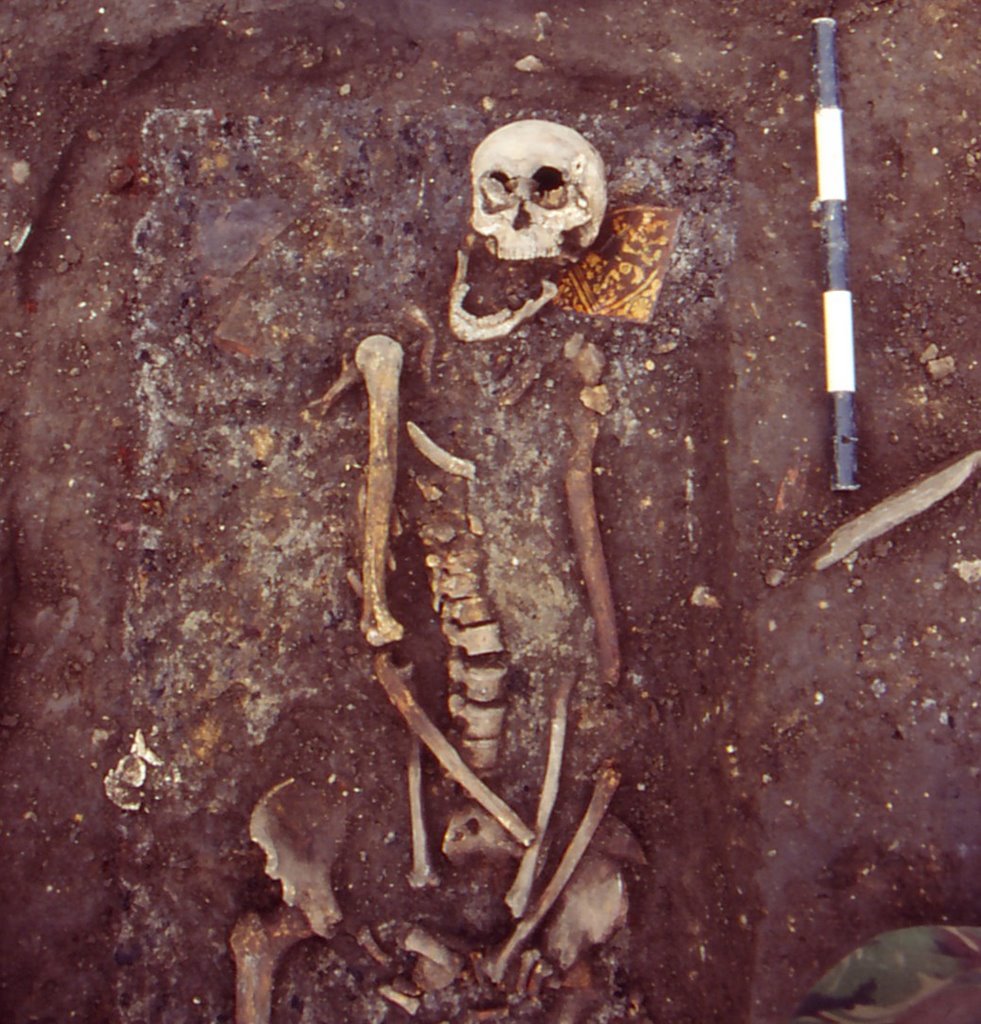 In November/December 2006's British Archaeology (Number 91, pages 20-21) Tony Gnanaratnam reports on the excavations in Leicester from April-December 2005 - Revealing a lost community. It was a large site which focussed on St Peter's medival church and cemetery. No doubt, at some point the article will gravitate to British Archaeology's web archive, sans photos. In the meantime, of interest to tile fans is the presence of two floor tiles in one of the graves:
... The coffin contained two floor tiles, one with the mid 14th century arms of the Dukes of Lancaster (the earldom of Leicester eventually passed to Lancaster)
There is also a photo of the grave, and it shows that one of the tiles was tucked behind the head of the skeleton. Published in the article, I also found it on the dig's website, so have included it here.
Monday, September 18, 2006
Early medieval ceramic roof tile in Yorkshire
Having got the funding to get proper drawings made of the curved and flanged tile thanks to a grant from the Yorkshire Architectural and York Archaeological Society, I can go ahead with my early medieval roof tile article. Curved and flanged roofing tile is currently dated to 12th-early 13th century and are superceded by plain roof tile (eg. peg or nib) from the late 12th century onward.
Curved and flanged tile functioned in the same way as the Roman imbrex and tegula. The following examples are from MAP Archaeological Consultancy's Spurriergate, York, site.
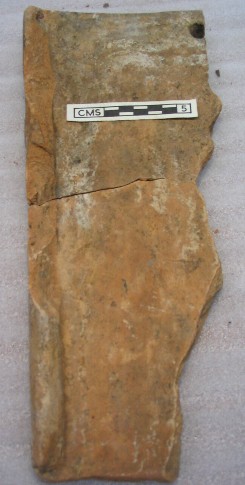
This is a flanged tile, with a nail/peg hole. Only half of one, but a complete one can be seen at the Museum of London catalogue site here:
 Here is a curved tile that would have gone along with the flanged tile above. As ever, it's not quite complete. Note it also has a nail/peg hole:
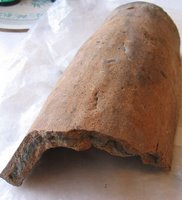 Although I have seen some partially glazed examples in York, it does not appear to be particularly common in the city.
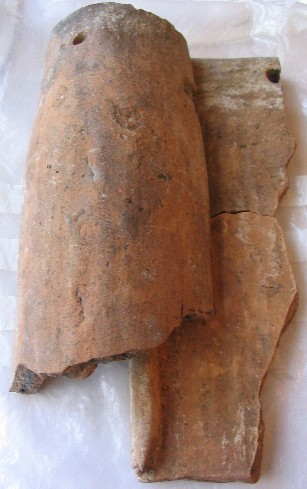
Here is how the tiles would be fitted together. Unlike Roman tiles, these tiles don't tend have upper and lower cutaways to lock into the next tiles on the roof. However, sometimes the flanges tiles as a whole taper toward the bottom, or the flange itself is slightly tapered at the end: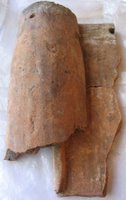
Curved and flanged tile functioned in the same way as the Roman imbrex and tegula. The following examples are from MAP Archaeological Consultancy's Spurriergate, York, site.
This is a flanged tile, with a nail/peg hole. Only half of one, but a complete one can be seen at the Museum of London catalogue site here:
 Here is a curved tile that would have gone along with the flanged tile above. As ever, it's not quite complete. Note it also has a nail/peg hole:
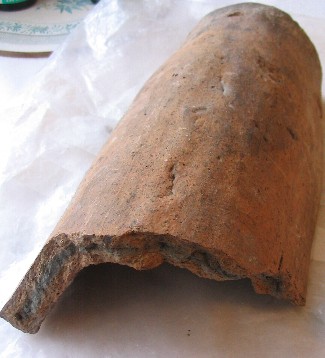 Although I have seen some partially glazed examples in York, it does not appear to be particularly common in the city.
Here is how the tiles would be fitted together. Unlike Roman tiles, these tiles don't tend have upper and lower cutaways to lock into the next tiles on the roof. However, sometimes the flanges tiles as a whole taper toward the bottom, or the flange itself is slightly tapered at the end:
Saturday, September 16, 2006
National Lottery flying bricks advert
As previously mentioned on this blog, there was a National Lottery advert featuring bricks flying through the air to a nice sunny location. This ad can now be viewed on line here. I may even go so far as downloading a copy :-)
Tuesday, September 05, 2006
Brick and Tile Recording Day 2006
Brick and Tile Recording Day
Wednesday 15th November 2006
10.00 to 4.30pm
Yorkshire Museum, Museum Gardens, York
Draft Programme
10.00am Tea/Coffee/Biscuits and Registration
10.15 Introductions
10.20 Why record Ceramic Building Materials? – Phil Mills (Freelance CBM specialist)
10.45 A brief guide to Ceramic Building Material types – Sandra Garside-Neville (CBM Researcher)
11.15 Tour of Ceramics Store – Andrew Morrison (Curator of Access for Archaeology, Yorkshire Museum)
12.15 Lunch (There are a number of cafes and pubs in the area, or please bring your own food as it is not
provided)
1.30 Hands-on brick and tile recording
3.00 Tea break
3.15 Hands-on brick and tile recording
4.30 Finish
Places are limited to 10 participants only and cost £45 for the day.
--------------------------------------------------------------------------------------------------------------------------------
If you're interested in attending, drop me a line at sgn1@fsmail.net
Subscribe to:
Posts (Atom)